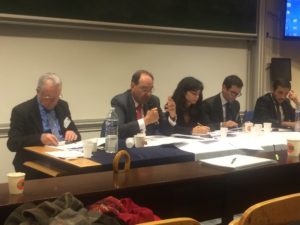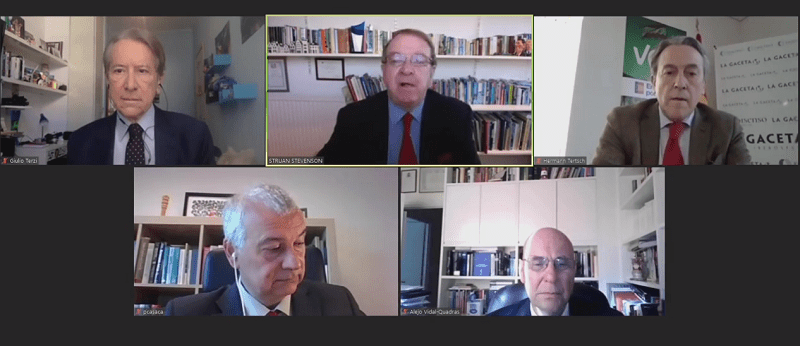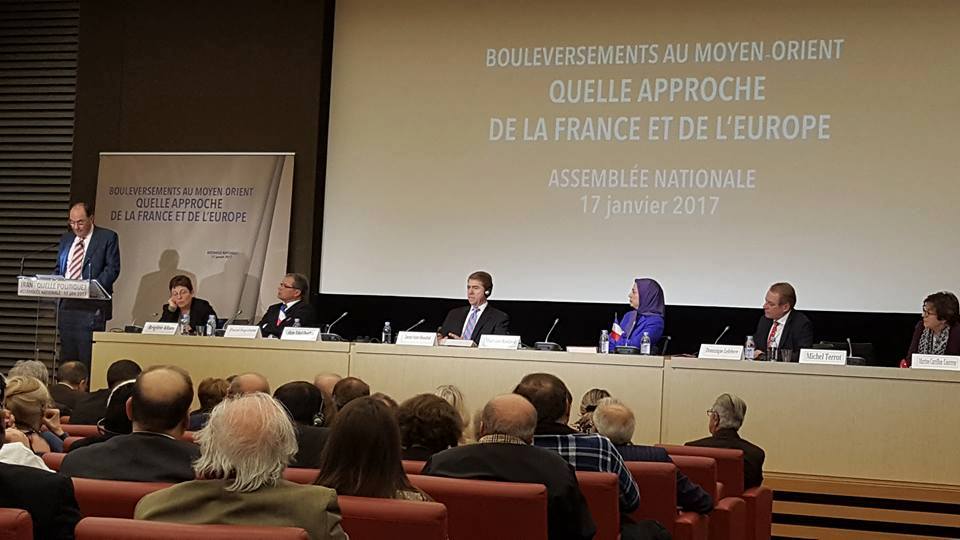

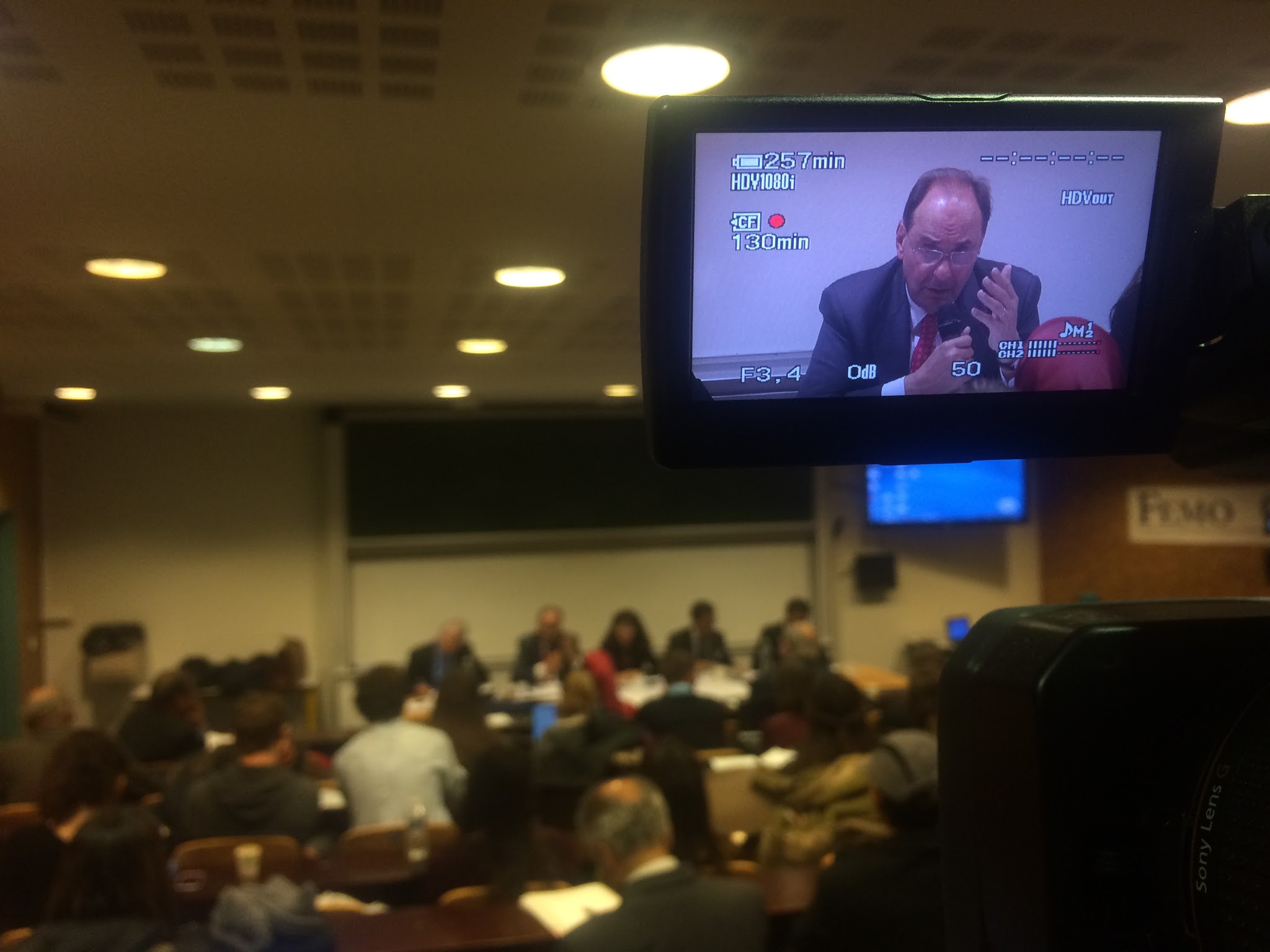
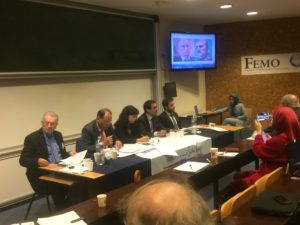
Speech by Dr. Alejo Vidal-Quadras in the international forum “Relations between the EU and Iran” at the University of Picardy Jules Verne, Amiens 7 of November 2016
Terrorism emanating from Islamic fundamentalism is now “terrorism without borders”.
The civilized world, with all its values and achievements, is facing an unprecedented challenge and a very serious risk. If the urgency of the problem is not in question, an appropriate response will still prove elusive for policymakers.
Clearly it is not a confrontation between the West and Islam, with over 1.7 billion followers. It is the reactionary and violent brand of Islam, with its political agenda under the guise of religion that is at the core of the conflict. Indeed, fundamentalism is a lethal ideology where Muslims are its first victims.
While the Syrian crisis and the rise of terrorist groups like the Islamic State or ISIS undermined our security in Europe, the adoption of an appropriate policy is an urgent task.
Until the 1970s, there was not a codified or structured ideology in the Muslim world that tolerated genocide or mass murder of moderate Muslims and Christians in the name of God and Islam, nor the rejection of national borders and the creation of a totalitarian government presented as an Islamic caliphate. There was of course terrorism in Palestine, Egypt and other Arab countries, but it was based on political considerations and not on a fanatical religious idea thirsty of blood.
The seizure of power by Ayatollah Khomeini in Iran in 1979 and the establishment of the first Muslim theocracy of the contemporary world was a key trigger in the onset of this phenomenon.
The special nature of Islamic fundamentalism must make us aware that we are no longer dealing with a geopolitical challenge that threatens the Middle East. It must be recognized that with the expansion of communications and the Internet age, these developments directly affect our societies. The number of Westerners going to fight in the ranks of ISIS and other terrorist groups reminds us that we are not facing a geopolitical challenge; we are facing threats that jeopardize the security of the world as a whole.
The stated goal of Islamic fundamentalism is to impose sharia law by force: it is the common denominator to all Islamist currents, from the Shiite mullahs in Iran to the caliphate of ISIS and Al Qaeda in other regions.
It should be recalled that it was the Ayatollah Khomeini, founder of the principle of the “absolute power of the supreme leader” that has used for the first time the term “Islamic caliphate” or “Muslim Caliph” to describe the Islamist power that he wanted to build in Iran. Besides their common goal, Shiite and Sunni fundamentalists share the same features: the violent enforcement of Sharia law, the establishment of a monstrous tyranny in the name of God’s government, espousing a universal Islamic caliphate without any respect for national borders, repression of women, the violation of fundamental human rights, repression of opponents of sharia, etc.
Iran is the most populous country in the region and it has borders with six Muslim countries. The influence of Iran on Muslim societies is much larger than its substantial power. Over the past centuries, Iranian scientists and academics have had a huge impact on the development and culture in Islamic countries.
The impact and the direct consequence of the formation of a fundamentalist regime in such an important country as Iran with its unparalleled position in the Islamic world, have allowed Tehran to become the spiritual, political and strategic godfather for all Islamists the world, despite their differences. The simple installation of a theocracy in such a key country as Iran has provided fundamentalist Islamist groups – previously marginalized and without an eye on political power – the ability and perspective to emerge as a destructive political force seeking to rise as a political State at any price.
 The systematic policy of Tehran, with the active use of subservient groups, has greatly accelerated this process, as it was case in the second half of the 20th century with the role of Moscow as supporter of the communist movements and states in the world. There were many Communist parties and Marxist with a lot of internal ideological differences, but Moscow was playing a vital role for all. However, with the fall of the Soviet Union, all these states and movements have received a fatal blow and are gone or found themselves isolated. Similarly it can be expected that if there will be a regime change in Tehran, most of these Islamic extremist groups will disappear.
Indeed, Tehran calls for a “global Islamic state” both in its Constitution and in other texts. Khomeini, the founder of the regime, and Ali Khamenei the current Supreme Leader, have openly considered themselves as the leaders of all Muslims around the world, not just Shiites.
In the Iranian constitution it is stated that “the army of the Islamic Republic and the Revolutionary Guards are established not only to protect the borders, but also with the mission of jihad in God’s way and the struggle for extend the rule of God’s law in the world”.
During these decades, Tehran has established organizations and institutions for the export and the promotion of Islamism in different forms. Although Tehran is a theocracy based on Shiite beliefs, it has not limited its strategy to the Sunni-Shiite borders. Tehran has specific bodies to influence and recruit Shiite and Sunni groups and personalities.
The creation and development of the Islamic State in Iraq and the Levant (ISIS) has been the new face of the fundamentalist movement in recent years. This group, with its Sunni archaic design, has its origins in a branch of Al-Qaeda in Iraq.
ISIS has skilfully exploited the legitimate anger and frustration vis-à-vis Sunni sectarian policies of the previous government of Iraq and was able to develop in Iraq. The bloody repression of Sunnis in Syria by Bashar Assad also contributed its part to the extension of this trend.
Assad has deliberately left ISIS settle in the oil-rich regions of Syria. He even released some prisoners so they can join ISIS and strengthen its ranks. The capital of the so-called Islamic Caliphate, Raqqa, wasn’t struck by the Assad’s aviation for long.
ISIS has had a symbiotic relationship with the Assad regime, which means that despite their differences, the two entities have vital interests in their mutual existence. In fact, Assad has created a situation where the international community is forced to choose between Assad and ISIS.
Western governments have failed to adopt a decisive policy against Bashar Assad, practically leaving his moderate opponents alone against the simultaneous attacks by ISIS, Assad and the Russians.
The urgent question today is how to deal with ISIS and suppress terrorist attacks against Europe
There are 3 options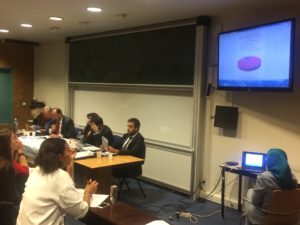
Option 1 – Adopt security measures in Europe, intensify air strikes against ISIS and tolerate Assad. As we have already seen, the many terrorist plots that have targeted Europe will not be stopped only by adopting stricter measures of internal security.
Even if ISIS is defeated, the threat is not going away in Europe if the presence of Assad gives the dynamism and inspiration to others to carry out terrorist acts in different parts of the world.
Option 2 – – Elimination of ISIS with help from Assad and Iran, which is the Iranian regime’s favourite option Keeping Assad in power would provide for continuation of the Iran’s interferences which in turn strengthens the atmosphere that is so vital for the existence of ISIS. The result would be a Shiite Caliphate of the Supreme Leader of the Iranian regime dominating the whole region instead of the ISIS Sunni Caliphate
Option 3 – Aim simultaneously to eliminate ISIS and Bashar Assad. Under this option, it is necessary to help the Syrian opposition because it can provide the necessary troops on the ground. This option will change the political and military conditions in Syria and deprive ISIS of its breeding. This will be the end of a five years disaster that left over 500,000 dead and more than 10 million homeless refugees. This will certainly reduce largely the causes for terrorism. This will stop the flow of refugees to Europe and could pave the way for the majority of current refugees to return to Syria. This option can provide a lasting solution.
The international community should adopt a policy to uproot Islamism at its root. The Iranian regime is today the only state in the world that actively and explicitly exports Islamic terrorism in the world. Today about 70,000 troops in Syria are directly or indirectly controlled and financed by the Iranian regime. As long as Assad remains in power terrorist groups as ISIS will continue to exist. The ultimate solution to the problem of Islamism is to eliminate the core of Islamist terrorism which is Iran; to confront Islamic fundamentalism we must promote democratic and tolerant Muslim movements: The Iranian Resistance under the leadership of Maryam Rajavi is the necessary antidote to Islamic fundamentalism. When Mrs. Rajavi speaks of separation between religion and state, gender equality, the abolition of the death penalty, freedom of expression and of thought, women’s rights etc. These words from a Muslim woman send shivers down the spine of the tyrants in turbans in Tehran.
The effects of the overthrow of the regime in Iran will be huge in the fight against this scourge as were the effects of them taking power in 1979. In this case, not only Hezbollah in Lebanon and the Houthis in Yemen, but al Qaeda and ISIS be everywhere substantially weakened. They will gradually diminish in influence until the point where they will become obsolete and isolated groups. In that case, the path will open for the establishment of democracies in Syria and Iraq, and it will allow to dry out the roots of Islamic fundamentalism in the world.