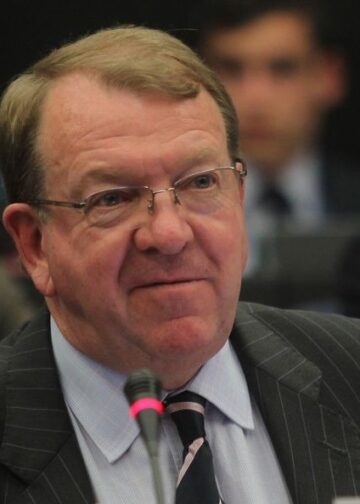

The following is the first part of a piece written by former MEP Struan Stevenson in the book “Iran Democratic Revolution,” published by the International Committee in Search of Justice (ISJ).
The first part of this writing can be found here:
Regime Tactics
The uprising and its longevity have exposed the regime’s intrinsic vulnerability and desperation to end or at least reduce the power of the unrest. At the time of writing, these unprecedented protests have expanded to at least 280 cities. Over 700 people have been killed and more than 30,000 have been arrested by the regime. Significantly, virtually all social sectors and demographics have voiced their opposition to the regime in one way or another, demonstrating the geographical breadth and social depth of frustration and utter disenchantment with the status quo. These circumstances have shaken the regime to its core, exponentially raising the probability of its overthrow. They have also put the spotlight on the regime’s main viable alternative, the National Council of Resistance of Iran (NCRI) and its major constituent, the Mujahedin-e Khalq (MEK).
Naming the main actor
Amid the grim realities for the regime in Iran and the social, political, and economic crises that have fueled the flames of unrest, a critical element has bolstered the uprising. The organized opposition, in the form of the MEK and particularly its Resistance Units inside Iran, has been instrumental in inspiring, leading, providing logistical support, and ensuring the persistence of the protests. An increasing number of regime officials and media outlets are alive to this reality and have publicly warned about the growing influence and reach of the MEK and its Resistance Units, particularly among the younger generation and women.
Supreme Leader Ali Khamenei’s main envoy within the Islamic Revolutionary Guard Corps (IRGC), said in November that nearly 50 of the primary “leaders” of the uprising arrested by the regime are MEK sympathizers. Mostafa Pour-Mohammadi, a member of the Death Commission during the 1988 massacre and former minister of interior and judiciary, admitted as far back as July 2019: “There has not been a single incident of destruction [against the regime] over the past 40 years in which the MEK has not had a leading role. We have not yet settled the score with the MEK We
are going to deal with every single one of them. We are not joking.”
The rapid expansion of MEK Resistance Units has long been on the regime’s radar. In 2019, the then-Intelligence minister Mahmoud Alavi reported: “Over the past year, 116 teams (“Resistance Units”) associated with the MEK have been dealt with.”3 In May 2019, Tehran’s Revolutionary Court sentenced an MEK activist Abdullah Ghassempour to death, while sentencing several others to imprisonment on charges of supporting the MEK.
On a number of occasions, no less an authority than Supreme Leader Ali Khamenei himself has publicly lambasted the MEK as the main organizer and leader of the nationwide protests. For example, in the midst of protests in 2020, Khamenei criticized Albania for hosting the MEK and said in a televised speech that the “small and sinister” country of Albania is now home to thousands of “treacherous” MEK members responsible for the unrest in Iran.
Khamenei added that the MEK “drew up plans” to lead the nationwide protests in November 2019. During the December 2017 protests, Khamenei had again acknowledged the MEK’s leading role, saying: “The MEK had prepared for this [protest] months ago.
… The MEK’s media outlet had called for it.”
All roads to regime change
There is a reason why the regime’s highest officials and security agencies have focused so intently on the MEK and its broadening activities. Over the past 40 years, the organization has been the first and only serious opposition movement calling for the entire theocracy’s overthrow and advocating for regime change at the hands of the Iranian people themselves. This has been the MEK’s consistent strategy since June 1981 when the clerical rulers massacred thousands of MEK supporters on the streets of Iran, leaving no other legitimate option but to call for the complete overthrow of the theocratic regime.
The 2022 uprising has shown in no uncertain terms that the MEK’s strategy was indeed correct and all other proposed alternatives, including “civil disobedience” and inducing vague behavior change in the regime, have been wholly ineffective and futile. Only by aligning with the strategy deployed by the MEK and Resistance Units can other options prove effective. Today, young people in the streets of Tehran and other cities are calling for the regime’s complete overthrow, attesting to the legitimacy and effectiveness of the MEK’s slogans and strategies over the past four decades. In unison with the MEK’s message, protesters are calling for regime change and democracy, explicitly rejecting both the previous monarchy and the current theocracy.
Diversionary tactics
This explains why the regime views the MEK and the NCRI coalition as existential threats. Tehran has engaged in multi-faceted tactics against the organized resistance movement to weaken, marginalize and ultimately destroy it.
On the one hand, during previous uprisings, the MOIS tried to promote the slogan “Reza Shah, may your soul rest in peace” to convey the notion that protesters are inclined to support the return of the monarchy. By doing so, the regime sought to demoralize protesters by advocating for the previous infamous dictatorship. But the attempt quickly failed. Video footage capturing scenes of protests, for example in Isfahan, showed demonstrators exposing those who chant slogans as members of the paramilitary Basij. At the same time, eyewitness testimonies exposed this plan even more. For example, Hashem Khastar, a teachers’ union representative who has spent a long time in Mashhad prison, called attention to attempts by the MOIS to promote monarchy over the MEK. He wrote:
“There is a sea of blood separating the regime and the MEK. Everybody knows that the biggest enemy of the regime is the MEK because it has an ironclad organizational prowess and as admitted by the rulers of the regime, they have been involved in all protests. On the contrary, the forces affiliated with the monarchists are incredibly scattered and unorganized. Therefore, the regime is trying to encourage dissidents to move toward the monarchists’ camp. Meanwhile, it has sent infiltrators within their ranks, who express support for the Crown Prince and attack the regime, while simultaneously attacking the MEK. In other words, they identify the main enemy as the MEK rather than the Islamic Republic. To make these individuals appear as credible opponents of the regime, some of them may even be jailed for a while, so that they can acquire a more acceptable standing and safety net, to be able to advance their mission more effectively. Other individuals may fall unwittingly in the intelligence agents’ trap and view the MEK, rather than the regime, as the primary enemy.”
RENOWNED IRANIAN TEACHER: “EVERYONE KNOWS PMOI/MEK IS THE REGIME’S MAIN ENEMY”
He also wrote in a post on the social media application Telegram: “In April 2018, when the intelligence agents raided my garden, they asked me why I do not work with the Crown Prince Reza Pahlavi. Would you like us to call his mobile so you to talk to him? I said no.”
Syrianization myth
The regime also tries to decelerate the MEK’s growing social reach by causing deviations when it comes to the protests’ primary aims and core messaging. It does this by attempting to distort reality, disseminate fake news, and fabricate a dominant narrative unfavorable to protesters. Tehran has promoted the message that if it were to be overthrown, Iran will risk becoming like Syria or Lebanon, especially considering the many ethnic and religious groups that comprise the country. “Civil war,” “Breaking Iran into pieces,” and “jeopardizing Iran’s territorial integrity” are code words used by the regime to both discourage new acts of protest and to legitimize the suppression of ongoing ones.
On October 31, 2022, for example, the official IRNA news agency quoted the regime’s foreign minister as saying that foreign entities are “plotting a civil war in Iran” and stressed that Iran’s “territorial integrity” is in danger due to the nationwide protests. On November 18, a senior IRGC commander, Majid Arjomandfar, similarly underscored the “enemies’ renewed attempts to break apart the Islamic Iran and sow the seeds of insecurity.”9 The daily Kayhan newspaper, close to the regime’s Supreme Leader Ali Khamenei, said on November 26 while pointing to the protests: “The enemy wants more bloodshed to keep the country in emergency circumstances and in the end move Iran toward civil war.”10 And on November 23, the IRGC’s political deputy said that the “enemy” carried out the recent “riots” in order to “create a Syrian scenario” in Iran.11
But in Iran, the ongoing nationwide protests encompass all classes, gender, ethnicity, and religious beliefs. Slogans from Kurdistan in the west to Sistan-va-Baluchistan in the east show that this is not a battle among ethnicities or religious groups. It does not pit a social or political majority against a minority or vice versa. Rather, virtually everyone is rallying around the slogans of “Death to Khamenei” (overthrow), and “Death to the oppressor, be it the Shah or the Leader” (charting a path forward to a democratic republic). Therefore, the regime’s hyperboles in this case are pure fiction simply designed to keep itself in power for as long as possible.
People across Iran, from Tehran, Isfahan and Mashhad, to Azerbaijan, Zahedan, and other cities in Baluchistan and Kurdish cities, chant slogans like “From Baluchistan to Tehran, I sacrifice my life for Iran,” or “From Kurdistan to Tehran, I sacrifice my life for Iran.” Therefore, it is clear that the progress of the uprising and the revolution against the entirety of the regime is leading to further expressions of unity and solidarity among Iran’s ethnicities.